


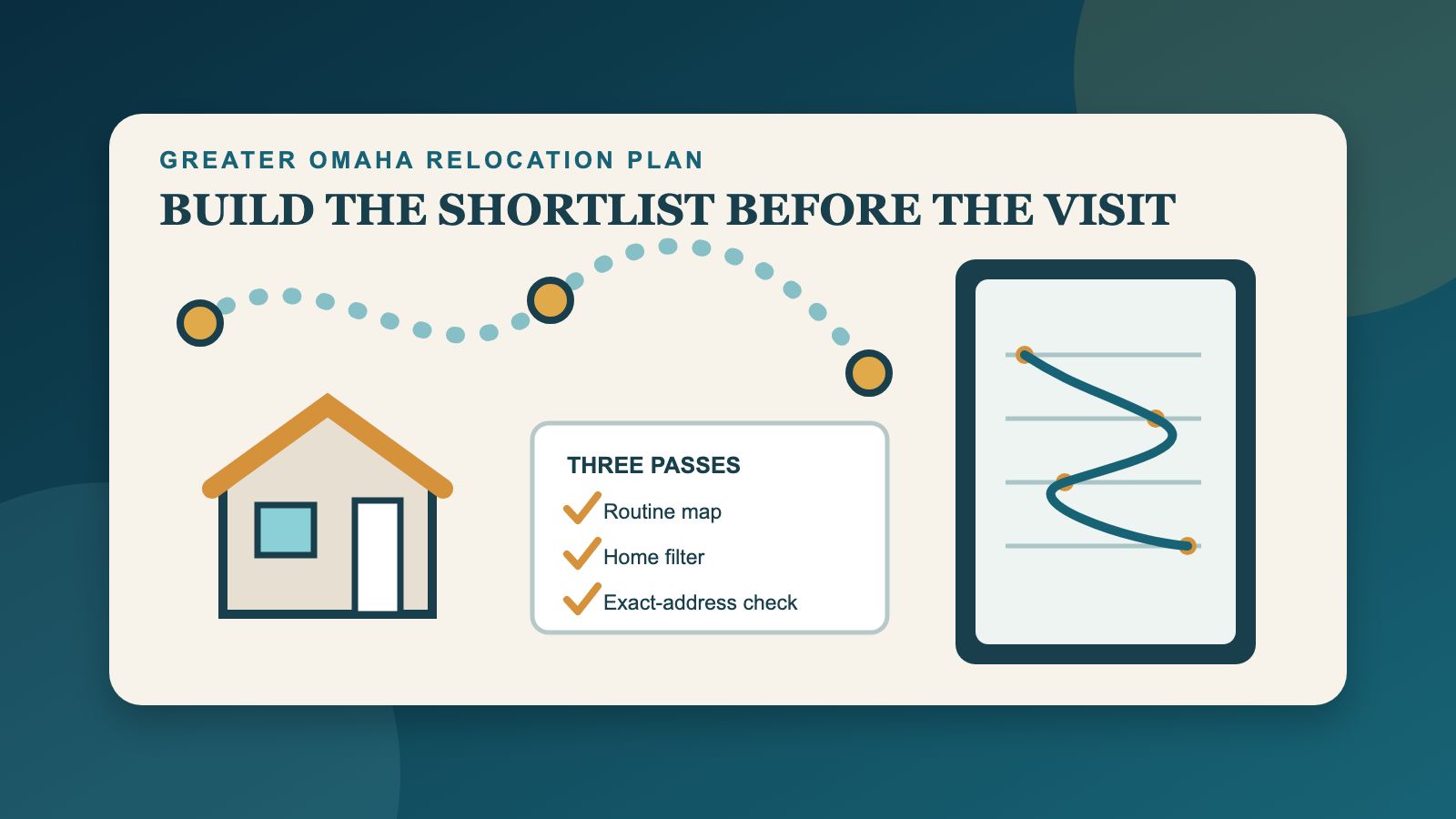
Short answer: Before visiting Omaha, narrow your home search in three passes: map the destinations and time windows that shape your real week, filter current homes by budget and property needs, then verify exact-address facts for the finalists. Carry only the properties or small search zones that survive all three passes into your scouting trip.
This is more reliable than choosing from a “best neighborhoods” list or assuming a mailing label establishes commute, school, tax, service, or district boundaries. Virtue Group uses an address-first, buyer-led process: you define the lawful priorities, and each candidate has to earn its place on the itinerary.
This is a general relocation-planning framework, not legal, tax, lending, insurance, inspection, school-assignment, or financial advice. Routes, inventory, boundaries, services, costs, and property records change; verify the exact address with the responsible source and qualified professional.
Arrive with a shortlist, not a ranking
A useful pre-visit shortlist is not a list of community names. It is a small set of homes or compact search zones connected to your actual routine, property requirements, and verified address facts.
That distinction matters in Greater Omaha. A familiar place name may describe a mailing address, a broad community identity, a school district, or a municipal boundary—but those labels do not answer every property-level question. Virtue Group’s published Greater Omaha community-comparison framework explains why the exact address must do the factual work.
The three-pass process below adds a relocation-specific goal: finish enough research remotely that your visit can test assumptions instead of starting from zero.
Pass 1: map the week you will actually live
Begin with destinations, frequency, and time windows—not neighborhood reputations. List the places that would shape your own routine: work, medical care, caregiving, airport trips, recreation, or other destinations you select.
For each anchor, record:
- Frequency: daily, several times a week, monthly, or occasional.
- Relevant time: when you would realistically make the trip, not only when traffic is light.
- Transportation need: driving, transit, walking, cycling, or a combination.
- Acceptable tradeoff: which route matters most when two priorities conflict.
Test representative routes at realistic times and save the date and time of the test. Nebraska 511 can provide current road and travel-condition information, while Metro’s maps, schedules, and trip-planning tools can help when transit is relevant. Treat both as snapshots. Construction, weather, congestion, and schedules change, and metro-wide service does not prove that a particular address is served.
A daily destination should generally carry more weight than a monthly errand—but the weighting is yours. This keeps the search buyer-led and avoids substituting an agent’s assumptions for your priorities.
Pass 2: filter by the home, not just the map
A location is not a useful candidate if the homes currently available there do not fit your requirements. Use live inventory to test the match, and keep requirements separate from preferences.
Write the non-negotiables first
- Purchase budget and a lender-informed payment range.
- Property type and minimum functional layout.
- Accessibility requirements selected by the buyer.
- Age, condition, renovation tolerance, and maintenance appetite.
- Lot, parking, storage, outdoor-space, or pet-related property needs.
- Existing-home versus new-construction preference.
- Moving window and any timing constraints.
Do not rely on a broad claim that an area “always” offers a certain price, home style, or level of competition. Listings change. Review the current Greater Omaha home search and judge the inventory available at the time you are planning.
Then identify the flexible preferences
Preferences might include finish style, yard size, renovation potential, or proximity to a buyer-selected amenity. Mark them as preferences so an attractive feature does not quietly override a true requirement.
At the end of this pass, remove any search zone that cannot currently produce realistic candidates. Keep a backup only when you can name what condition would make it viable, such as a different moving window or a revised property requirement.
Pass 3: check exact addresses before booking the trip
Detailed verification is most efficient after the route and home filters have reduced the list. For each finalist, identify what is confirmed, what remains unanswered, and who is responsible for the answer.
Jurisdiction, parcel, and current tax record
Start with the responsible jurisdiction and the county parcel record. The Nebraska Department of Revenue maintains a directory to county parcel-search systems, including Douglas and Sarpy Counties. A current parcel record is a starting point—not a future tax quote, title opinion, or guarantee that every property obligation appears there.
HOA, SID, utilities, and services
Ask whether the property is subject to an HOA, sanitary and improvement district, special assessment, or other recorded obligation. Request the current documents where applicable. Verify utility providers and municipal services for the address rather than inferring them from the mailing city or ZIP code.
Flood and insurance questions
Use FEMA’s Flood Map Service Center for current public flood-hazard information, then obtain a property-specific insurance quote. Flood maps may be updated, and a map result is not an insurance determination or cost estimate.
School information only when you request it
If school assignment is one of your stated criteria, use the official NebraskaMap School District Lookup as a starting reference and confirm the exact-address assignment directly with the responsible district. Boundaries and assignments can change. Virtue Group does not rank schools or use school information as a proxy for the people who live in an area.
Transit for the actual address
Check the current route, stop, direction, operating day, and schedule that would apply to the property. Do not assume that general transit coverage extends to every address or works for your time window.
Turn the survivors into a scouting-trip route
Three to five candidates is often more useful than an exhausting list, but there is no required number. The right shortlist is the smallest set that gives you meaningful choices without repeating the same unanswered questions.
Group stops around the routes you would actually use rather than around subjective neighborhood labels. When practical, revisit a finalist at another relevant time. Observe what is directly visible or audible: street access, nearby land uses, sound at that moment, property condition, and route friction. Record observations as time-stamped notes—not universal claims about an area.
If a candidate fails a non-negotiable during the visit, document why and move on. If the issue is simply unknown, assign the follow-up to the responsible source or professional instead of guessing.
Remote-to-visit handoff sheet
Use the same fields for every candidate so a visually appealing listing does not receive easier treatment than the others.
- Candidate address or compact search zone: enough detail to repeat the research without publishing private relocation information.
- Buyer requirement met: the specific non-negotiable that kept it on the list.
- Route test: origin, destination, mode, date, time, and observed result—with no promise that it will repeat.
- Home fit: budget, layout, condition, lot, maintenance, accessibility, and timing notes.
- Exact-address facts checked: jurisdiction, parcel record, flood information, and applicable HOA, SID, utility, service, transit, or requested school sources.
- Open questions: each question paired with the responsible government office, district, lender, insurer, attorney, inspector, title professional, or other qualified source.
- Reason it survived: one factual sentence tied to your criteria.
Keep this sheet private. Do not place addresses, travel patterns, financial details, medical information, access codes, or documents containing personal data in a shared link unless you understand and accept who can access it.
What this method cannot decide for you
No relocation worksheet can identify a universal “best” area. It also cannot promise a commute, school assignment, tax bill, insurance cost, inventory level, appreciation result, or neighborhood safety outcome.
A fair, useful search process provides the same objective verification to every buyer and lets the buyer choose lawful criteria. It does not characterize residents, predict who belongs in a community, or recommend locations based on race, color, national origin, religion, sex, familial status, disability, or related proxies.
Build your Greater Omaha shortlist with Virtue Group
Virtue Group’s buyer process can help connect your weekly anchors and property requirements to current listings, then organize the address-level questions that remain. You can also use the Greater Omaha area guides as broad orientation—not as a substitute for exact-address research.
Bring your weekly anchors, home requirements, budget, and moving window to a relocation search-planning conversation. The goal is a focused itinerary built around your life and verified property facts.