


Short answer: A strong offer is not simply the one with the highest price or the fewest protections. It is a clear, credible package whose dates, financing, funds, contingencies, and possession terms fit the property, the seller’s lawful priorities, and what the buyer can actually perform. Before changing any term, ask what it may solve for the seller, who must confirm it is feasible, and what risk it shifts to you.
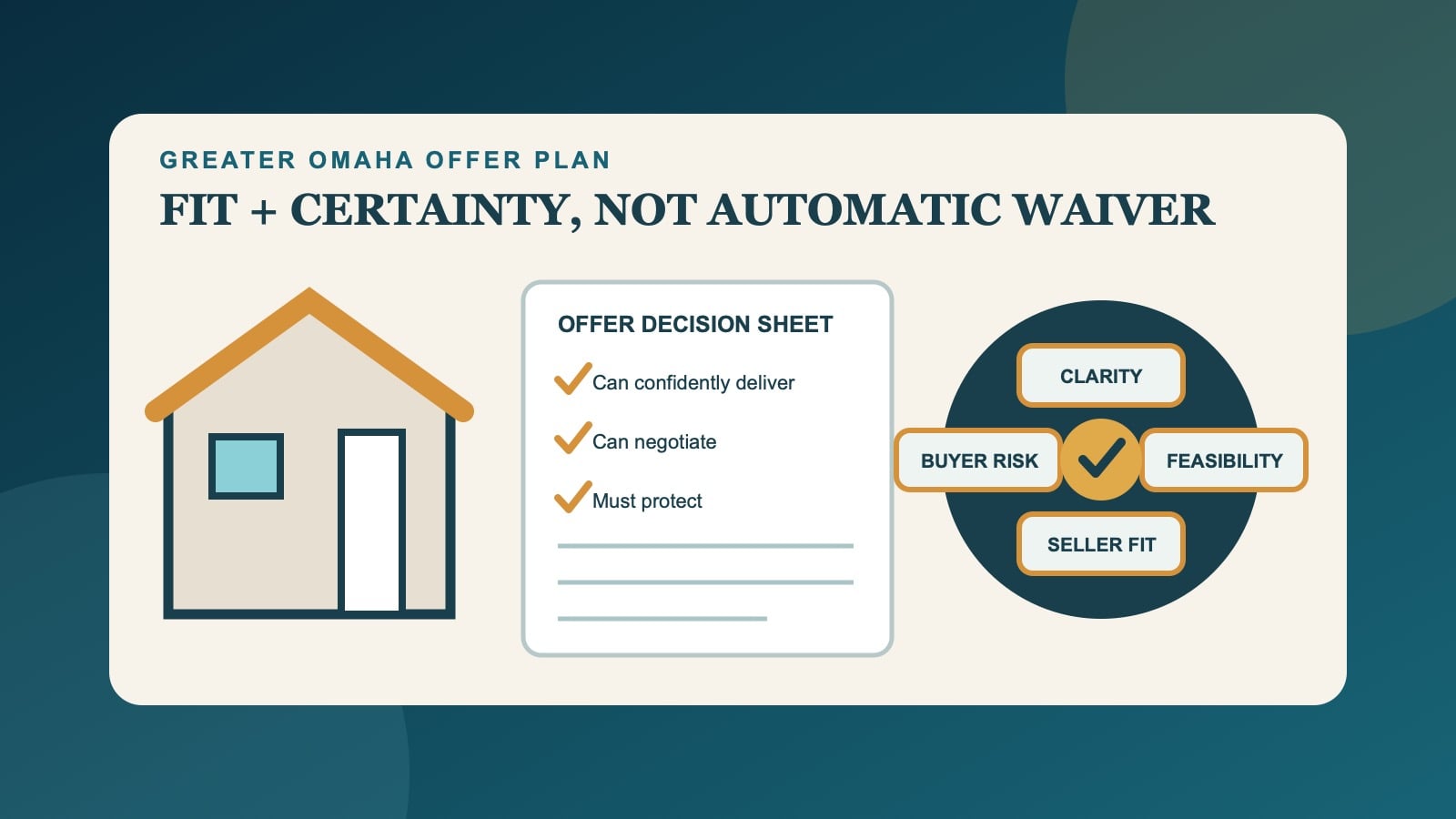
Virtue Group’s Greater Omaha offer-planning framework starts with three columns—can confidently deliver, can negotiate, and must protect—then checks each proposed term for clarity, feasibility, seller fit, and buyer risk. The point is not to create a universal “winning offer.” It is to help you make deliberate choices before signing.
This article provides general home-buying information, not legal, lending, tax, insurance, appraisal, inspection, or financial advice. Offer terms and consequences depend on the property, written agreement, financing, and current law. Review your specific offer with your licensed real estate professional, lender, and attorney or other qualified adviser as appropriate before signing.
Strength means fit plus certainty—not automatic waiver
A seller may accept an offer as written, reject it, or make a counteroffer. The Nebraska Real Estate Commission’s consumer resources also direct contract questions to a real estate licensee or attorney. No checklist can predict the seller’s decision, and no individual term is always “stronger.”
A responsible offer gives the seller a package that is easy to understand while preserving the buyer’s informed choices. Completeness matters. So does coordination: an attractive date is not credible if the lender, insurer, closing provider, or buyer’s own calendar cannot support it.
Set your maximum price and cash boundary before adjusting non-price terms. That keeps flexibility on timing or possession from quietly expanding the total financial risk.
Start with three columns: deliver, negotiate, protect
Before drafting terms, sort the buyer’s choices into three columns. This is Virtue Group’s practical way to separate real flexibility from wishful thinking.
Can confidently deliver
List what has already been coordinated and documented: available funds, lender status, a feasible closing window, document-response speed, and decision-makers who will be available. Do not promise a date merely because it looks appealing. Identify who confirmed it and when.
Can negotiate
List terms you can adjust without undermining why you are buying the home. Depending on the property and seller’s stated needs, that might include the closing date, possession timing, response deadline, or treatment of certain included items. “Negotiable” does not mean consequence-free; it means you understand the tradeoff and have room to choose.
Must protect
Record your property-specific due diligence, financing boundaries, cash reserves, housing needs, and legal protections. These are not generic instructions to keep or remove a particular contingency. They are issues you will not change without understanding the written agreement, confirming the practical impact, and obtaining appropriate professional advice.
Which non-price terms can affect an offer?
Non-price terms can matter because they change timing, certainty, cost, or risk. Their importance varies by seller and property, so use the listing side’s lawfully communicated priorities rather than guessing at the seller’s identity or motivation.
Closing date and possession
A seller may care about when the transaction closes or when possession changes. Ask what timing has been communicated, then verify that the lender and closing providers can support it. Clarify whether closing and possession occur together. Do not promise early occupancy, delayed possession, or another arrangement without the approved written documents and property-specific advice.
Earnest money
Earnest money can demonstrate that the buyer is prepared to proceed, but a larger amount does not guarantee acceptance or refundability. Delivery, custody, default, disputes, and disposition depend on the agreement and applicable rules. Ask what is required, when it is due, where it will be held, and what events affect it before selecting an amount.
Financing documentation and readiness
Prompt, accurate lender documentation may help show that the proposed financing and dates have been discussed. A preapproval is not final loan approval. Confirm the loan type, underwriting status, appraisal requirements, cash to close, and realistic closing window with the lender. Share only what the transaction requires; redact account numbers and unrelated private information.
Inspection approach
Inspection terms can change access, deadlines, response options, and the buyer’s remedies. They should not be treated as a performance of toughness. Nebraska’s residential disclosure statute says the seller disclosure is not a warranty or a substitute for an inspection or warranty a purchaser may wish to obtain. Review the current disclosure, the exact property, inspector availability, and the written agreement before deciding.
Appraisal-related terms
An appraisal is an independent opinion of value, not a property inspection. The Consumer Financial Protection Bureau’s appraisal guidance explains that a lender may require one. Any change to appraisal-related terms can affect the buyer’s cash needs and contractual risk; confirm the lender’s requirements and review the exact language before agreeing.
Other contingencies and included property
A current-home-sale contingency, financing condition, title issue, insurance availability, or included fixture may materially affect feasibility. Identify included and excluded items clearly. Do not rely on a verbal side agreement, and do not use an editorial checklist as contract language.
Run every proposed term through four checks
Once a possible adjustment is identified, test it through four lenses. The same term may pass for one buyer and fail for another.
- Clarity: Is the term complete, internally consistent, and stated in the approved written agreement? Are dates, amounts, and responsibilities unambiguous?
- Feasibility: Has the responsible lender, insurer, inspector, title or closing provider, employer, attorney, or other professional confirmed what must happen?
- Seller fit: Does the term answer a priority actually communicated through the listing side, or is it only a guess?
- Buyer risk: What money, deadline, remedy, due diligence, or housing plan changes if the term is accepted?
Write down the answer to all four. If feasibility or risk is unknown, the term is not ready merely because an offer deadline is approaching.
“Clean” should mean coordinated—not stripped of safeguards
Calling an offer “clean” can hide the most important question: clean for whom, and at what cost? A better goal is coordinated. The offer should contain what is required, avoid contradictions, use achievable dates, and reflect decisions the buyer understands.
Do not assume that removing inspection, financing, appraisal, title, disclosure, or other protections is routine or harmless. The Nebraska seller-disclosure statute expressly says the disclosure is not a warranty or a substitute for an inspection or warranty the purchaser may wish to obtain, subject to the statute’s applicability and exceptions.
The CFPB also cautions that a contract with the seller may limit a financed buyer’s time and flexibility to close, and that buyers should review financing-contingency language to understand what may happen to a deposit if financing fails. Read the CFPB’s mortgage-closing guidance, then obtain advice on your own agreement rather than assuming a general rule.
Hold a Greater Omaha offer huddle before signing
A short, structured review can surface contradictions before they become contract problems.
- Buyer and agent: review listing instructions, property facts, stated lawful seller priorities, agreement completeness, deadlines, included items, and unresolved questions.
- Lender: confirm loan type, underwriting status, appraisal needs, available funds, documentation, and a feasible closing date.
- Buyer: restate the price and cash ceiling, timing needs, housing plan, risk tolerance, and must-protect items.
- Other professionals as needed: assign questions to an attorney, inspector, insurer, title or closing provider, tax adviser, or another qualified specialist.
Record who confirmed each time-sensitive item and when. If a professional has not confirmed something within their role, label it unresolved instead of turning an assumption into a promise.
For a broader overview of financing, tours, offers, inspections, and closing, review Virtue Group’s Omaha home-buying guide. Buyers considering a builder agreement should use the separate Greater Omaha new-construction offer checklist, because specifications, lot obligations, warranties, and completion terms create a different decision.
What not to use as leverage
Keep the offer focused on objective terms. Do not include a personal “love letter,” family photos, religion, disability, national origin, familial status, or other protected-class details. Do not ask the seller to choose based on who the buyer is rather than the transaction terms. This protects a fair process and avoids unnecessary privacy exposure.
Also avoid false urgency, unverifiable proof of funds, hidden side agreements, or a promise the buyer cannot perform. Share sensitive financial documents only through the approved secure process and only to the extent required.
Use this offer decision table
Complete one row for every proposed non-price change. Keep the table with the transaction team rather than in a public or broadly shared document.
| Term | Buyer’s goal | Stated seller need | Who must confirm | Deadline or cost | Buyer risk | Decision |
|---|---|---|---|---|---|---|
| Closing or possession date | What problem does it solve? | What was actually communicated? | Lender and closing provider | Dates and housing impact | Delay, overlap, or performance risk | Keep, change, or clarify |
| Earnest money | Why this amount? | Is an amount specified? | Agent or attorney as appropriate | Delivery and custody | Agreement-specific disposition | Keep, change, or clarify |
| Inspection term | What due diligence is needed? | No assumption required | Agent, inspector, attorney as appropriate | Access and response dates | Condition and remedy risk | Keep, change, or clarify |
| Financing or appraisal term | What can the buyer support? | What was actually communicated? | Lender and attorney as appropriate | Cash and loan deadlines | Financing, deposit, or cash risk | Keep, change, or clarify |
Add rows for title, insurance, sale-of-current-home, included property, response timing, or any other term in the specific offer. Never fill a row with “standard” unless a qualified source has confirmed what that means for this transaction.
Build a property-specific offer plan
Bring the property, your lender’s confirmed limits, your timing, and your must-protect items to a Greater Omaha offer-planning conversation. Virtue Group can help organize the questions, coordinate the relevant professionals, and prepare a clear strategy for the property—without promising acceptance or asking you to give up a protection you do not understand.